Showing posts with label top. Show all posts
Showing posts with label top. Show all posts
Saturday, February 14, 2015
Online Compilers The Top 5 Websites to Write Compile and Run Programs Online
Have you ever thought about writing and compiling c or c++ programs online. Are you getting bored of using c, c++, java or any other compilers in your computer? If yes then here I come with a solution. In this article I am going to share some websites that provide facility to compile and run programs of different languages like c, c++, java, python, etc. directly on internet. I have done a research on internet and find the top 5 websites given below that provides this facility. So just visit them, use them and let me know about your experience.

Also Read: GCC Compiler: Download Code::Blocks 12.11 a Free C/C++ IDE
Also Read: How to Write and Run C/C++ Programs in Ubuntu (Linux)


Also Read: How to create your own Header Files in C/C++?
Also Read: C4droid: Download Free C/C++ Compiler for Android Platform


Also Read: GCC Compiler: Download Code::Blocks 12.11 a Free C/C++ IDE
Also Read: How to Write and Run C/C++ Programs in Ubuntu (Linux)
The Top 5 Best Online Compilers
codepad.org
Codepad.org is an online compiler/interpreter, and a simple collaboration tool. Its a pastebin that executes code for you.ideone.com
Ideone is something more than a pastebin. Its an online compiler and debugging tool which allows to compile and run code online in more than 40 programming languages.compilr.com
Compilr is an online editor & sandbox that lets you write your code all from the comfort of your browser.Also Read: How to create your own Header Files in C/C++?
Also Read: C4droid: Download Free C/C++ Compiler for Android Platform
compileonline.com
It is another good online compiler which allows writing and running programs in more than 50 programming languages.onlinecompiler.net
It is not good and famous as above compilers. This allow you to write and run programs only in 6 languages i.e. c, c++, fortran, java, pascal and basic.
Thursday, February 12, 2015
Best Java Books Top 5 Best Java Programming Books
What are the best java books? This is the first question that comes in our mind when we start learning java programming. So in this article I have made a list of top 5 best java programming books on the basis of their popularity. These books are written for easy learning and are highly recommended for beginners.
List of Top 5 Best Java Books
Java: A Beginners Guide

- Get this Book -
Table of Contents
Java Fundamentals
Introducing Data Types and Operators
Program Control Statements
Introducing Classes, Objects, and Methods
More Data Types and Operators
A Closer Look at Methods and Classes
Inheritance
Packages and Interfaces
Exception Handling
Using I/O
Multithreaded Programming
Enumerations, Autoboxing, Static Import, and Annotations
Generics
Applets, Events, and Miscellaneous Topics
Introducing Swing
Answers to Self Tests
Using Javas Documentation Comment
Index
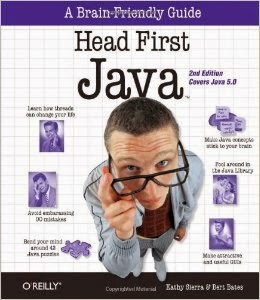
Head First Java
- Get this Book -
Table Of Contents
Introduction
Breaking the Surface: a quick dip
A Trip to Objectville: yes there will be Object
Know Your Variables: primitives and references
How Objects Behave: object state affects method &Junior
Extra-Strength Methods: flow control operations, and more
Using the Java Library: so you dont have to write it all yourself
Better Living in Objectville: planning for the future
Serious Polymorphism: exploiting abstract Classes and interfaces
Life and Death of an Object: constructors and memory management
Numbers Matter: math, formatting, wrappers; and statics
Risky Behavior: exception handing
A Very Graphic Story: intro to GUI, event handling, and inner classes
Work on Your Swing: layout managers to subcomponents
Saving Object: serialization and I/0
Make a Connection: networking sockets and multi-threading
Data Structures: collections and genetics
Release Your Code: packaging and deployment
Distributed Computing: RMI with a dash of serialize, EJE, and Jini
Appendix A: Fatal code kitchen
Appendix B: To 7th Mugs that &diet make it into the rest of the book
Index
Effective Java

- Get this Book -
Table of Contents
Foreword
Preface
Acknowledgments
Introduction
Creating and Destroying Objects
Methods Common to All Objects
Classes and Interfaces
Generics
Enums and Annotations
Methods
General Programming
Exceptions
Concurrency
Serialization
Appendix: Items Corresponding to First Edition
References
Index
Java - The Complete Reference

- Get this Book -
Table of Contents
Part I: The Java Language
The History and Evolution of Java
An Overview of Java
Data Types, Variables and Arrays
Operators
Control Statements
Introducing Classes
A Closer Look at Methods and Classes
Inheritance
Packages and Interfaces
Exception Handling
Multithreaded Programming
Enumerations, Auto-boxing and Annotations (Meta-data)
I / O, Applets and Other Topics
Generics
Lambda Expressions
Part II: The Java Library
String Handling
Exploring java.lang
Java.util Part 1 - The Collections Framework
Java.util Part 2 - More Utility Classes
Input / Output - Exploring Java.io
Exploring NIO
Networking
The Applet Class
Event Handling
Introducing the AWT - Working with Windows, Graphics and Text
Using AWT Controls, Layout Managers and Menus
Images
The Co-currency Utilities
The Stream API
Regular Expressions and Other Packages
Part III: Introducing GUI Programming with Swing
Introducing Swing
Exploring Swing
Introducing Swing Menus
Part IV: Introducing GUI Programming with JavaFX
Introducing JavaFX GUI Programming
Exploring JavaFX Controls
Introducing JavaFX Menus
Part V: Applying Java
Java Beans
Introducing Servlets
Appendix: Using Java’s Documentation Comments
Index
Programming With Java

- Get this Book -
Table of Contents
Chapter 1: Fundamentals of Object-Oriented Programming
Chapter 2: Java Evolution
Chapter 3: Overview of Java Language
Chapter 4: Constants, Variable and Data types
Chapter 5: Operators and Expressions
Chapter 6: Decision Making and Branching
Chapter 7: Decision Making and Looping
Chapter 8: Classes, Objects and Methods
Chapter 9: Arrays, Strings and Vectors
Chapter 10: Interfaces: Multiple Inheritance
Chapter 11: Packages: Putting Classes Together
Chapter 12: Multithreading Programming
Chapter 13: Managing Error and Exceptions
Chapter 14: Applet Programming
Chapter 15: Graphics Programming
Chapter 16: Managing Inputs/Output Files in Java
Chapter 17: Java Collections
Appendices
Appendix A: Java Language Reference
Appendix B: Java Keywords
Appendix C: Difference between Java C/C++
Appendix D: Bit-level Programming
Appendix E: Java API Packages
Appendix F: Java Classes and their Packages
Appendix G: Assertion and Design by Contract
Appendix H: Java Version History
Appendix I: Deprecated Classes and Methods
Appendix J: Statistics of Java Packages
Appendix K: SCJP Exam Model Questions
Appendix L: Points to Remember
Appendix M: Common Coding Errors
Appendix N: Glossary of Java Terms
Appendix O: Projects
Bibliography
Index
Top 10 Websites to Improve Programming and Coding Skills
The best way to improve programming and coding skills is to solve problems regularly. To make your task a little bit easier I have done research and found some awesome websites. In this article I am sharing some best websites that provides puzzles and problems. You can enhance your skills by solving these problems in any language you know. Some of these websites also organize competitions regularly. If you have good skills you can even win cash prizes by winning such competitions.
Also Read: List of Biggest and Popular Programming Contests
Also Read: List of Biggest and Popular Programming Contests
Top 10 Websites to Improve Programming and Coding Skills
Codechef

HackerRank

Project Euler

Topcoder

Programming Praxis

Codeeval

Code Jam

LeetCode

CodingBat

Coderbyte

If you know about more such websites than please mention it in the comment section, I will love to add them in this list.
Happy Coding!! :) :)
Tuesday, February 10, 2015
Top 5 Tools to Create Interesting Infographic

Infographics are big image files that disseminate information of some sort. That is the modern definition of an Infographic, even though technically a modern online infographic is just a mere “type” of Infographic. Still, the image file Infographics you see online are popular because they have an SEO (Search Engine Optimization) value and they are attractive for readers to look at. There is no science to creating a modern Infographic, nor are there any sorts of rules. Here are five tools you can use to create your very own Infographics.
Also Read: Whats New With Windows 8.1? Release Date and Features
Also Read: Download WhatsApp for any Java Phone for free [100% Working]
1. InFoto
This is a free tool that you can use to create Infographics that are centered on how you take your photographs. A lot of people enjoy taking photos on their mobile devices, and some people have files full of images that nobody is ever going to see again. This tool helps those people to make use of their old photos, and it helps professional Infographic creators to create more original Infographics.
The Infographics tool will mine data from your photograph and then help you create an Infographic based upon that information. It is very easy to use as it does most of the work for you. It is free but you do have to suffer through adverts. You should give it a try if you are running out of ideas for your new batch of Infographics.
2. Vizualize
This is a tool that has lots of functions for people who want to make an Infographic about themselves. It has lots of functions that would be ideal for creating an Infographic CV, but they can be used for different purposes such as explaining how long you have had a certain client, or the achievements of your website or company.
The nice thing about this tool is that you can look at how other people have used the tool to create their Infographics, and then use the tool to copy what they did. You can then alter and customize your Infographic so that it does not look as if you have taken inspiration from another person. It is a good tool to use in conjunction with other tools.
3. Google Developers
This is a tool that allows you to connect with Google and collect data in real time so that you can add it to your Infographics. It gives you a wide choice of charts that you can use, and they all contain information that it available on Google. You can change and configure the charts so that they are more in keeping with the style of your Infographics or even of your website.
Also Read: The Top 4 Websites to Create Android Apps Online for Free
Also Read: The Top 8 Best Alternatives to Google Play Store to Download Android Apps for Free
Lots of people use this tool for their website to make their website appear a little less like the work of a bumpkin, and make it look a little more professional. You can apply the same rules to your Infographics and make them look more professional with the charts you gain from the Google developers’ tool.
4. Piktochart
This is the software that you see on most lists of this nature. It allows you to create charts with their tools and you can customize them so that they do not look like the charts everybody else has created with this tool. You can add in a lot of alterative graphics you can use with the tool, you can customize the font and change the color scheme to match your Infographics.
The tool is free to use, but you can upgrade your version to a more advanced one if you are planning on making multiple different Infographics. The templates you use are lined, so you can set things out on your Infographic page without worrying about them being wonky or misaligned. You can also resize things and keep them in proportion as you do it.
5. Easel.ly
This tool has lots of different Infographics templates that you can use to create your Infographics. It is sometimes difficult to try and come up with a brand new Infographic out of thin air. Sometimes you need a little something to get your started, and that is where this tool may help you. The templates are fairly simple and are all customizable so you do not have to create Infographics that look like everybody else’s.
It also has different tools and editorial functions that you can use, such as connector lines and shapes. You can also adjust your text styles and sizes. You can adjust your Infographics colors and upload your own graphics whilst adjusting your Infographic fonts.
Author’s bio:
My name is Sonia Jackson. I write for www.cool-essays.comthat provides well-written and quality essays and research papers for college and university students.
Subscribe to:
Posts (Atom)