Showing posts with label best. Show all posts
Showing posts with label best. Show all posts
Sunday, February 15, 2015
Best Way to Easily Find and Remove Broken Links from your Website or Blog

What are Broken Links?
Broken links are the links which leads to a page that actually does not exist. When you publish any article on your blog than search engines like Google indexe it and add your article information to its database. After some days or months if you delete your previously published article than it is removed from your blog database but not from Google database. If anyone search for a keyword related to your article on Google than your article link come up in the search results. And if he/she clicks on the link then it leads to a 404 error page.Also Read: The Top 10 Websites to create free Logo for your Blog
404 error pages and broken links have a negative effect on SEO and which decreases your search engine ranking. Let’s take an example to explain it more clearly. Suppose if you search for a keyword on Google, than so many search results come up. When you click one of them you may come across a 404 error page. Now tell me that, what you will do in this situation? You will immediately leave that site and go for another one. Google consider this as bad practice and which gradually leads to decrease in your search engine ranking.
In this post I am going to tell you the best way to easily find and remove broken links from your blog. This can be done by using an online tool Google Webmaster Tool. This is one of the tool that I occasionally use to detect and remove broken links from my blog. If you have a blogger blog then there is no need to register but if you have a wordpress blog then you have to first register your blog. Let’s see how to remove these useless links from Google database.
Also Read: Tips on How to Have Better SEO Results with Link Building
How to Find and Remove Broken Links?
1. First of all login to Google Webmaster Tool by going to the link given below:
http://www.google.com/webmasters/
2. Now go to Dashboard and select the blog that you want (if you have more than one) from the drop down menu situated at right top.
3. Go to Health>Crawl Errors and than click on Not found option as shown below.

(click on the image to enlarge)
4. After that you will see a list of all the broke links in your blog. Than click on any link from the list, now a new pop-up window will open, copy the link from there.
5. Now go to Optimization>Remove URLs and than click on Create a new removal request, paste the link that you have copied earlier in the box as shown below and than click on Continue button.

(click on the image to enlarge)
6. A new window will open,there click on Submit Request as shown below.

(click on the image to enlarge)
8. You have done…..! Do you have any query? You are free to ask, just comment below.
Note: Google webmaster Tool will take some time to remove these URLs from Google database.

Friday, February 13, 2015
40 Best Free Brand Identity Stationery PSD Mockups

In this competitive business world,presenting your company to your clients in a good way is the first step for the complete success. Branding is one of the most fundamental skills of any good designer.
Creating great branding indentity is one thing, but using modern and interesting ways of displaying your design using products can lift up your game. A lot of freelance designers start off doing small branding jobs which include stationery and full identity work.
There are plenty of free mockup templates available that designers can use. Brochures,CD covers,bags,stationery,business cards can be a perfect solution for your company identity.
Today, we have collected over 40 Best Free PSD Stationery and Brand Identity Mockups from across the web to help you bring your next branding project to realisation.
1- Stationary Branding Mock Up PSD

2- Free Stationery PSD Mockup

3- Free Branding & Stationary Mock-up PSD

4- Identity / Branding MockUp PSD

5- Branding / Identity MockUp PSD

6- Branding / Identity PSD MockUp

7- Stationery PSD Mockup

8- Free Branding / Identity PSD MockUp

9- Free PSD Stationery Branding Mockup Pack

10- Free Branding / Identity MockUp PSD

11- Branding Identity PSD Mock-Up

12- PSD Branding / Identity Mock-Up

13- Stationery Branding PSD Mock Up

14- A4 Paper PSD Mock-Up

15- Free PSD Branding / Identity MockUp

16- Free Identity PSD Mockups Design

17- Corporate Branding Mockup PSD

18- Free PSD Branding / Identity Mock-Up

19- PSD Corporate Identity MockUp

20- Branding / Identity Mock-Up PSD

21- Stationery Branding Mock Up PSD

22- Free Stationery Branding Mock-Up PSD

23- Free PSD Branding Mock Up

24- Free Jack & Son Identity PSD

25- Free Corporate Branding Identity PSD

26- Branding Stationery Mockup PSD

27- Free PSD Branding Stationery Mockup

28- Stationery Presentation Mock Up PSD Template

29- Identity Branding Stationery PSD Mockup

30- Branding Stationery Mock-Up PSD

31- Free Stationery Mockup PSD

32- Free Stationary Mockup PSD Template

33- Branding Identity MockUp Template PSD

34- Identity Mockup PSD

35- Free Corporate Branding Template PSD

36- Wooden Stationery MockUp PSD

37- Free Branding Mock-up PSD

38- Corporate Identity PSD Mock-up

39- Free PSD Stationery Mockup

40- Flat Stationery MockUps PSD

4 Best Tips For iOS Application Development
There is no question of the popularity of iOS platform. In the Smartphone world, the iOS platform is the most admired mobile OS. However, it is ranked as the second best platform if their market shares are considered (as, Android possesses over 85% share whereas iOS exhibits around 12% market share). But, no one can deny the fact that the iOS apps generates much greater revenue than the Android applications. Thus, developing an iOS application will definitely benefit your business.

If you are interested in trying your hand in the iOS app development, there are a few tools and things that must be known beforehand to accomplish the task in an ideal way. There is no dearth of iOS applications in the Apple App Store, to make your app stand out of the crowd, its better to refer some expert guidance and assistance. Here are certain tips and tricks that can help you stay ahead of the curve.
Also Read: Wearable Tech - Wearable Application Development Technology
For efficiently promoting an application
Author Bio
Rick Brown is an app programmer for Mobiers Ltd – a leading iOS App Development Company. In case, you are willing to avail some related information and want to explore more about the technology, feel free to contact him.
If you are interested in trying your hand in the iOS app development, there are a few tools and things that must be known beforehand to accomplish the task in an ideal way. There is no dearth of iOS applications in the Apple App Store, to make your app stand out of the crowd, its better to refer some expert guidance and assistance. Here are certain tips and tricks that can help you stay ahead of the curve.
Also Read: Wearable Tech - Wearable Application Development Technology
Tips For iOS Application Development
1. Quite Basic but highly essential requirement: Mac and Xcode
To begin the iOS app development, a Mac device is a must and preferably it should be OS X 10.8 or a higher version, since, it can ensure a smooth and proficient development process. Another basic requirement is the Xcode, an Apple IDE (Integrated Development Environment) that offers an ideal app development framework. It is recommended to install the latest version of Xcode and develop your iOS application with greater precision with the included prolific tools.2. App Approval From The App Store Is Not The Ultimate Victory
Although, registering a developers account and getting your developed app approved from the Apple App Store is an imperative step, but it is just half the battle. By just getting the approval, your app will not get noticed and generate money. For that, you will need to promote your app with ideal marketing strategies.For efficiently promoting an application
- First of all, streamline your target audience by keeping the prime goal of your application in mind. This will help you make strives for surefire results.
- To ensure that your app gets some initial momentum upon its release in the App Store, it is essential to optimize your app for better marketing. The iTunes basically acts as a search engine, and thus can crawl the keyword-rich app content and index them with ease.
- Create an online presence of your application to efficiently promote it. Although, the App store facilitates a page to showcase the captivating attributes of your app, but you cant rely only on that . You either create a blog or website to support your application. There you can flaunt all the intriguing features and amazing capabilities of your application.
- You can even hire some experts to promote your app over different channels to attract potential customers.
- Analytics can help you determine your user behavior, so that you can make strives in the correct direction and improve your app.
- Consider your customer feedback. Whether its a positive feedback or negative, accept it. And, try to amend the best possible solution to further improve your app.
- Generate as much buzz as you can and gather the attention of journalists bloggers worldwide. This will encourage them to write about your app and thus, will help efficiently promote your app. And, this can definitely do wonders on the launch day of your app.
Also Read: IOS vs Android - Difference and Comparison [Infographic]
3. Stay Calm And Be Patient
Developing an iOS application is not a childs play. It could take a few days or a few months, depending upon how complex your application is. From the moment you get some innovative application idea in your head to the moment it gets approved could take a lot of time. In fact, once you submit your app for approval, it is not essential that it will immediately get published. The process could consume a substantial time, thus, it is better to stay patient and watch out the results.4. Other Essential Key Points For Your Consideration
- Plan well while equally balancing both the design and development strategies.
- Keep the targeted audience in mind while developing an application. This way you will be able to develop something useful that can best cater to the needs of your potential customers.
- Dont wait for application development to be completed, you can start promoting your application alongside the development process. This way you can create a good market base for your application.
- Most importantly, dont forget that you are targeting the touch-screen devices. Think of the app functions and features while keeping that in mind.
Final Thought
The aforementioned useful tips and facts can help you ensure a great iOS application development with an optimal approach. Go through these tips and prepare yourself for the forthcoming challenges that you might face during the development process. Create a remarkable application and promote it globally to enhance your business values and generate greater ROI.Author Bio
Rick Brown is an app programmer for Mobiers Ltd – a leading iOS App Development Company. In case, you are willing to avail some related information and want to explore more about the technology, feel free to contact him.
Thursday, February 12, 2015
Best Java Books Top 5 Best Java Programming Books
What are the best java books? This is the first question that comes in our mind when we start learning java programming. So in this article I have made a list of top 5 best java programming books on the basis of their popularity. These books are written for easy learning and are highly recommended for beginners.
List of Top 5 Best Java Books
Java: A Beginners Guide

- Get this Book -
Table of Contents
Java Fundamentals
Introducing Data Types and Operators
Program Control Statements
Introducing Classes, Objects, and Methods
More Data Types and Operators
A Closer Look at Methods and Classes
Inheritance
Packages and Interfaces
Exception Handling
Using I/O
Multithreaded Programming
Enumerations, Autoboxing, Static Import, and Annotations
Generics
Applets, Events, and Miscellaneous Topics
Introducing Swing
Answers to Self Tests
Using Javas Documentation Comment
Index
Head First Java
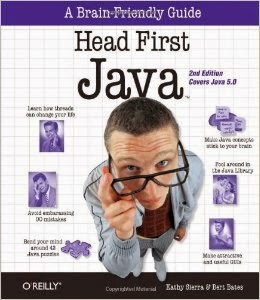
- Get this Book -
Table Of Contents
Introduction
Breaking the Surface: a quick dip
A Trip to Objectville: yes there will be Object
Know Your Variables: primitives and references
How Objects Behave: object state affects method &Junior
Extra-Strength Methods: flow control operations, and more
Using the Java Library: so you dont have to write it all yourself
Better Living in Objectville: planning for the future
Serious Polymorphism: exploiting abstract Classes and interfaces
Life and Death of an Object: constructors and memory management
Numbers Matter: math, formatting, wrappers; and statics
Risky Behavior: exception handing
A Very Graphic Story: intro to GUI, event handling, and inner classes
Work on Your Swing: layout managers to subcomponents
Saving Object: serialization and I/0
Make a Connection: networking sockets and multi-threading
Data Structures: collections and genetics
Release Your Code: packaging and deployment
Distributed Computing: RMI with a dash of serialize, EJE, and Jini
Appendix A: Fatal code kitchen
Appendix B: To 7th Mugs that &diet make it into the rest of the book
Index
Effective Java

- Get this Book -
Table of Contents
Foreword
Preface
Acknowledgments
Introduction
Creating and Destroying Objects
Methods Common to All Objects
Classes and Interfaces
Generics
Enums and Annotations
Methods
General Programming
Exceptions
Concurrency
Serialization
Appendix: Items Corresponding to First Edition
References
Index
Java - The Complete Reference

- Get this Book -
Table of Contents
Part I: The Java Language
The History and Evolution of Java
An Overview of Java
Data Types, Variables and Arrays
Operators
Control Statements
Introducing Classes
A Closer Look at Methods and Classes
Inheritance
Packages and Interfaces
Exception Handling
Multithreaded Programming
Enumerations, Auto-boxing and Annotations (Meta-data)
I / O, Applets and Other Topics
Generics
Lambda Expressions
Part II: The Java Library
String Handling
Exploring java.lang
Java.util Part 1 - The Collections Framework
Java.util Part 2 - More Utility Classes
Input / Output - Exploring Java.io
Exploring NIO
Networking
The Applet Class
Event Handling
Introducing the AWT - Working with Windows, Graphics and Text
Using AWT Controls, Layout Managers and Menus
Images
The Co-currency Utilities
The Stream API
Regular Expressions and Other Packages
Part III: Introducing GUI Programming with Swing
Introducing Swing
Exploring Swing
Introducing Swing Menus
Part IV: Introducing GUI Programming with JavaFX
Introducing JavaFX GUI Programming
Exploring JavaFX Controls
Introducing JavaFX Menus
Part V: Applying Java
Java Beans
Introducing Servlets
Appendix: Using Java’s Documentation Comments
Index
Programming With Java

- Get this Book -
Table of Contents
Chapter 1: Fundamentals of Object-Oriented Programming
Chapter 2: Java Evolution
Chapter 3: Overview of Java Language
Chapter 4: Constants, Variable and Data types
Chapter 5: Operators and Expressions
Chapter 6: Decision Making and Branching
Chapter 7: Decision Making and Looping
Chapter 8: Classes, Objects and Methods
Chapter 9: Arrays, Strings and Vectors
Chapter 10: Interfaces: Multiple Inheritance
Chapter 11: Packages: Putting Classes Together
Chapter 12: Multithreading Programming
Chapter 13: Managing Error and Exceptions
Chapter 14: Applet Programming
Chapter 15: Graphics Programming
Chapter 16: Managing Inputs/Output Files in Java
Chapter 17: Java Collections
Appendices
Appendix A: Java Language Reference
Appendix B: Java Keywords
Appendix C: Difference between Java C/C++
Appendix D: Bit-level Programming
Appendix E: Java API Packages
Appendix F: Java Classes and their Packages
Appendix G: Assertion and Design by Contract
Appendix H: Java Version History
Appendix I: Deprecated Classes and Methods
Appendix J: Statistics of Java Packages
Appendix K: SCJP Exam Model Questions
Appendix L: Points to Remember
Appendix M: Common Coding Errors
Appendix N: Glossary of Java Terms
Appendix O: Projects
Bibliography
Index
Subscribe to:
Posts (Atom)