Showing posts with label array. Show all posts
Showing posts with label array. Show all posts
Saturday, February 14, 2015
C program to find largest and second largest no from a 2D array
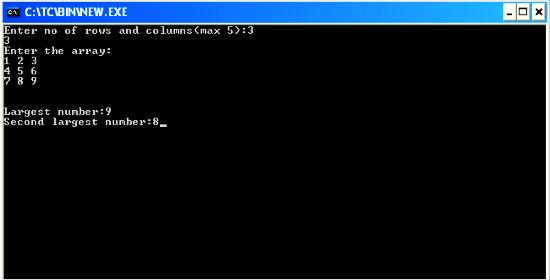
#include<iostream.h>
#include<conio.h>
void main()
{
clrscr();
int a[5][5],big1,big2,n,m,i,j;
cout<<"Enter no of rows and columns(max 5):";
cin>>m>>n;
cout<<"Enter the array:
";
for(i=0;i<m;i++)
for(j=0;j<n;++j)
cin>>a[i][j];
big1=a[0][0];
for(i=0;i<m;++i)
for(j=0;j<n;++j)
{
if(a[i][j]>big1)
big1=a[i][j];
}
big2=a[0][0];
for(i=0;i<m;++i)
for(j=0;j<n;++j)
{
if(a[i][j]>big2&&a[i][j]<big1)
big2=a[i][j];
}
cout<<"
Largest number:"<<big1;
cout<<"
Second largest number:"<<big2;
getch();
}

C Program for Implementation of Circular Queue Using Array
#include<stdio.h>
#define MAX 10
typedef struct Q
{
int R,F;
int data[MAX];
}Q;
void initialise(Q *P);
int empty(Q *P);
int full(Q *P);
void enqueue(Q *P,int x);
int dequeue(Q *P);
void print(Q *P);
void main()
{
Q q;
int op,x;
initialise(&q);
do
{
printf("
1)Insert
2)Delete
3)Print
4)Quit");
printf("
Enter Your Choice:");
scanf("%d",&op);
switch(op)
{
case 1: printf("
Enter a value:");
scanf("%d",&x);
if(!full(&q))
enqueue(&q,x);
else
printf("
Queue is full !!!!");
break;
case 2: if(!empty(&q))
{
x=dequeue(&q);
printf("Deleted Data=%d",x);
}
else
printf("
Queue is empty !!!!");
break;
case 3: print(&q);break;
}
}while(op!=4);
}
void initialise(Q *P)
{
P->R=-1;
P->F=-1;
}
int empty(Q *P)
{
if(P->R==-1)
return(1);
return(0);
}
int full(Q *P)
{
if((P->R+1)%MAX==P->F)
return(1);
return(0);
}
void enqueue(Q *P,int x)
{
if(P->R==-1)
{
P->R=P->F=0;
P->data[P->R]=x;
}
else
{
P->R=(P->R+1)%MAX;
P->data[P->R]=x;
}
}
int dequeue(Q *P)
{
int x;
x=P->data[P->F];
if(P->R==P->F)
{
P->R=-1;
P->F=-1;
}
else
P->F=(P->F+1)%MAX;
return(x);
}
void print(Q *P)
{
int i;
if(!empty(P))
{
printf("
");
for(i=P->F;i!=P->R;i=(i+1)%MAX)
printf("%d ",P->data[i]);
printf("%d ",P->data[i]);
}
}

#define MAX 10
typedef struct Q
{
int R,F;
int data[MAX];
}Q;
void initialise(Q *P);
int empty(Q *P);
int full(Q *P);
void enqueue(Q *P,int x);
int dequeue(Q *P);
void print(Q *P);
void main()
{
Q q;
int op,x;
initialise(&q);
do
{
printf("
1)Insert
2)Delete
3)Print
4)Quit");
printf("
Enter Your Choice:");
scanf("%d",&op);
switch(op)
{
case 1: printf("
Enter a value:");
scanf("%d",&x);
if(!full(&q))
enqueue(&q,x);
else
printf("
Queue is full !!!!");
break;
case 2: if(!empty(&q))
{
x=dequeue(&q);
printf("Deleted Data=%d",x);
}
else
printf("
Queue is empty !!!!");
break;
case 3: print(&q);break;
}
}while(op!=4);
}
void initialise(Q *P)
{
P->R=-1;
P->F=-1;
}
int empty(Q *P)
{
if(P->R==-1)
return(1);
return(0);
}
int full(Q *P)
{
if((P->R+1)%MAX==P->F)
return(1);
return(0);
}
void enqueue(Q *P,int x)
{
if(P->R==-1)
{
P->R=P->F=0;
P->data[P->R]=x;
}
else
{
P->R=(P->R+1)%MAX;
P->data[P->R]=x;
}
}
int dequeue(Q *P)
{
int x;
x=P->data[P->F];
if(P->R==P->F)
{
P->R=-1;
P->F=-1;
}
else
P->F=(P->F+1)%MAX;
return(x);
}
void print(Q *P)
{
int i;
if(!empty(P))
{
printf("
");
for(i=P->F;i!=P->R;i=(i+1)%MAX)
printf("%d ",P->data[i]);
printf("%d ",P->data[i]);
}
}
Tuesday, February 10, 2015
C program to sort an Array by using Bubble sort

#include<stdio.h>
#include<conio.h>
void main()
{
int a[50],n,i,j,temp;
clrscr();
printf("Enter the size of array: ");
scanf("%d",&n);
printf("Enter the array elements: ");
for(i=0;i<n;++i)
scanf("%d",&a[i]);
for(i=1;i<n;++i)
for(j=0;j<(n-i);++j)
if(a[j]>a[j+1])
{
temp=a[j];
a[j]=a[j+1];
a[j+1]=temp;
}
printf("Array after sorting: ");
for(i=0;i<n;++i)
printf("%d ",a[i]);
getch();
}
Wednesday, February 4, 2015
How to find the Greatest common divisor of an integer array in java
In this post Im going to illustrate very simple algorithm to find the Greatest Common Divisor (GCD) of set of integers (an array) using java.
See the following implementation of the algorithm.
Here is the output for 15, 18, 42 and 108

Here is the output for 3,7 and 12

Read more »
- In this algorithm we first find the smallest integer in the int array.
- Then we get the modulus for each element in the numbers of the array by dividing smallest integer and add all those modulus together.
- After processing each element in the array we check if the total of modulus is equals to 0. If it is equal to 0 then the GCD is current smallest value if that total is not equals 0 we deduct 1 from the previous smallest value and do the same computation.
- The algorithm will continue with the same operations until total of modulus becomes 0 or until smallest integer is 2.
- If there is any GCD, algorithm will return it or otherwise it will return -1.
See the following implementation of the algorithm.
public class GCD {

    public static int findGcd(int... numbers) {

        //Find the smallest integer in the number list

        int smallest = numbers[0];

        for (int i = 1; i < numbers.length; i++) {
            if (numbers[i] < smallest) {
                smallest = numbers[i];
            }
        }

        //Find the GCD
        while (smallest > 1) {

            int counter = 0;
            int modTot = 0;

            while (counter < numbers.length) {

                modTot += numbers[counter] % smallest;
                counter++;

            }

            if (modTot == 0) {
                //Return the gcd if any
                return smallest;
            }

            //System.out.print(" "+ smallest);
            smallest--;

        }
        //return -1 if there is no gcd
        return -1;
    }

    public static void main(String[] x) {
        System.out.println("The GCD of 15 18 42 108 : "+GCD.findGcd(new int[]{15, 18, 42,108}));
    }
}
Here is the output for 15, 18, 42 and 108
Here is the output for 3,7 and 12
Subscribe to:
Posts (Atom)